

Most athletes and bodybuilders view collagen peptides as “fake protein” due to their lack of essential amino acids.
This assessment is based on what collagen lacks rather than what it contains, and it ignores a body of research on the biological activity of its primary amino acid…
Glycine
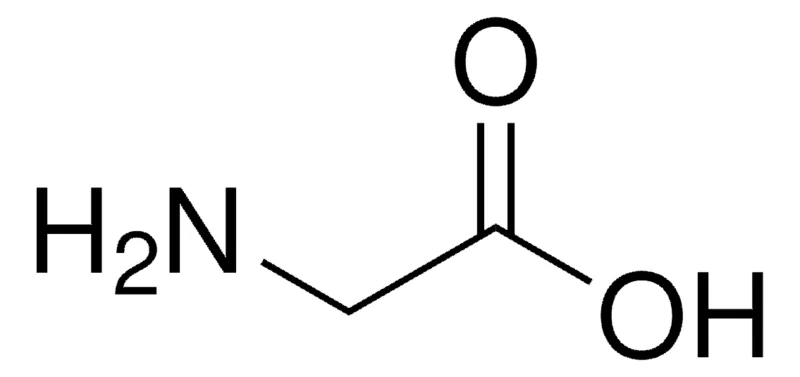
Glycine makes up approximately 25–30% of collagen by weight.
It has documented anabolic, anti-catabolic, and anti-inflammatory properties—some of which operate through muscle protein synthesis directly, and others through independent mechanisms.
The research below covers several areas where collagen peptides and glycine have demonstrated meaningful effects relevant to training and body composition.
Collagen peptides improve body composition and strength in resistance training
A randomized, double-blind, placebo-controlled trial of 53 elderly sarcopenic men found that 15g of collagen peptides per day combined with 12 weeks of resistance training produced significantly greater improvements in fat-free mass and muscle strength than placebo. Both groups followed an identical training program. The collagen group gained 4.2kg of fat-free mass compared to 2.9kg in the placebo group. [1]
Glycine is anti-catabolic under inflammatory conditions
An animal study found that glycine supplementation in tumor-bearing mice—a model for severe muscle wasting—attenuated the loss of fat and muscle mass, reduced markers of inflammation including IL-6, reduced atrophic signaling, and tended to preserve muscle function and reduce oxidative stress. The protective effect was compared against isonitrogenous doses of alanine and citrulline and found to be specific to glycine. [2]
3g of glycine before bed improves sleep quality and next-day performance
A double-blind, placebo-controlled study in sleep-restricted healthy volunteers found that 3g of glycine taken before bedtime significantly reduced fatigue, improved daytime sleepiness, and produced significant improvements in psychomotor vigilance the following day. Sleep was restricted to 25% below normal for three consecutive nights. [3]
The mechanism appears to involve peripheral vasodilation and a reduction in core body temperature rather than sedation or melatonin modulation. Given that sleep quality directly affects muscle protein synthesis, hormonal output, and training performance, this is a relevant finding for anyone training under conditions of sleep restriction.
Collagen peptides reduce muscle soreness and fatigue after exercise
A randomized, double-blind crossover trial in 20 healthy middle-aged men found that 10g of collagen peptides per day for 33 days significantly reduced muscle soreness and fatigue immediately after a standardized exercise bout compared to placebo. The collagen group also maintained greater knee extension force in the days following exercise. [4]
Reduced post-exercise soreness and faster force recovery support a higher training frequency, which is a primary determinant of long-term strength and hypertrophy adaptations.
Glycine activates mTORC1 and directly inhibits muscle protein degradation
A cell study found that glycine enhanced muscle cell growth by activating the mTORC1 pathway—the same signaling pathway activated by leucine and resistance exercise—while simultaneously inhibiting the expression of MuRF1 and atrogin-1, the two primary genes responsible for muscle protein breakdown. Protein synthesis increased by 20–80% and protein degradation decreased by 15–30% in a concentration-dependent manner. [5]
Glycine restores the anabolic response to leucine under inflammatory conditions
A mouse study found that inflammation induced by LPS completely blunted the normal anabolic response to leucine. Pre-treatment with glycine restored leucine-stimulated muscle protein synthesis by 51%, accompanied by higher phosphorylation of mTOR, S6, and 4E-BP1. [6]
This is directly relevant to training. Intense exercise produces an acute inflammatory response. Glycine has been shown to restore anabolic sensitivity under inflammatory conditions in animal models, suggesting a meaningful role in post-exercise recovery independent of its direct anti-catabolic effects.
Collagen peptide supplementation supports connective tissue synthesis
A systematic review of 15 randomized controlled trials found that collagen peptide supplementation combined with exercise supported extracellular matrix biosynthesis in tendons, ligaments, and intramuscular connective tissue, reduced joint pain, and accelerated recovery from connective tissue injuries. [7]
This is the aspect of collagen supplementation that has the most consistent support across studies and is the most directly applicable to athletes. Connective tissue is the limiting factor in training volume for most experienced lifters, and it responds to nutrition differently from muscle tissue.
Collagen peptides are not a replacement for complete protein sources.
The case for including them is that glycine—their primary amino acid—actively regulates muscle protein turnover, supports anabolic signaling under inflammatory conditions, improves sleep quality and next-day performance, and reduces post-exercise soreness and fatigue. Collagen also provides the structural precursors for connective tissue synthesis that complete proteins do not.
The most practical way to get enough glycine is through a combination of food sources and supplementation.
Food sources of collagen and glycine include:
Bone broth
Oxtail
Osso buco
Chicharrones
Ground beef
Skin-on cuts of meat
Whole fish
Organ meats
Eggs
For supplementation, I use the following:
Glycine: I source mine from LifeBlud. Use code MALACHY for 10% off at checkout.
Collagen peptides: Great Lakes Wellness collagen peptides are my preferred source.
Gelatin: Great Lakes Wellness also has a good gelatin, which is simply collagen in its unhydrolyzed form. The amino acid profile and glycine content are identical.
[1] Zdzieblik et al. (2015), Collagen peptide supplementation in combination with resistance training improves body composition and increases muscle strength in elderly sarcopenic men
[2] Ham et al. (2013), Glycine administration attenuates skeletal muscle wasting in a mouse model of cancer cachexia
[3] Bannai et al. (2012), The effects of glycine on subjective daytime performance in partially sleep-restricted healthy volunteers
[4] Kuwaba et al. (2023), Dietary collagen peptides alleviate exercise-induced muscle soreness in healthy middle-aged males: a randomized double-blinded crossover clinical trial
[5] Sun et al. (2016), Glycine Regulates Protein Turnover by Activating Protein Kinase B/Mammalian Target of Rapamycin and by Inhibiting MuRF1 and Atrogin-1 Gene Expression in C2C12 Myoblasts
[6] Ham et al. (2016), Glycine restores the anabolic response to leucine in a mouse model of acute inflammation
[7] Khatri et al. (2021), The effects of collagen peptide supplementation on body composition, collagen synthesis, and recovery from joint injury and exercise: a systematic review