

Learned helplessness is what happens when an organism—human or animal—is exposed to repeated adverse conditions it cannot control, and subsequently stops trying to escape those conditions even when escape becomes possible.
“Helplessness is a state in which nothing a person opts to do affects what is happening. It is the quitting or the give up response that follows the conviction that whatever a person does doesn’t matter.”
— Sivakumar Nuvvula
It is not a characteristic trait or a fixed state. It is a learned response, and like most learned responses, it can be unlearned.
The concept has implications that extend well beyond psychology. It touches on how the brain responds to stress at a biological level, how environment shapes physiology, and what conditions are required for an organism to function at its full capacity. It is also one of the more well-documented phenomena in behavioral science, with a research history stretching back to the 1950s.
This article covers that history, the biology behind it, and one researcher’s broader interpretation of what learned helplessness reveals about stress, the nervous system, and how we live.
The Original Research
The groundwork was laid not by Martin Seligman, who is most commonly associated with the concept, but by Curt Richter, a Johns Hopkins researcher who published a paper in 1957 titled “On the Phenomenon of Sudden Death in Animals and Man.” [1]
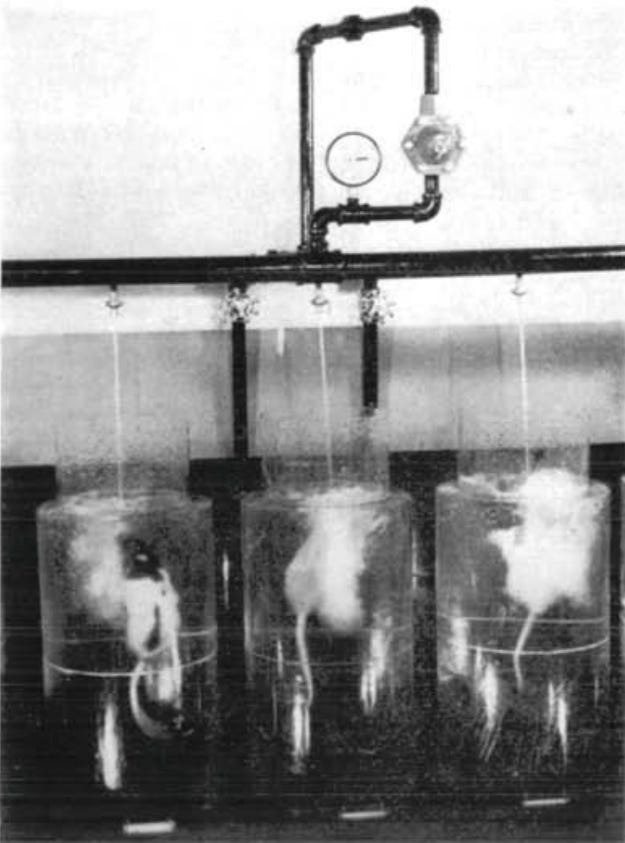
Richter wanted to understand why animals sometimes died suddenly under conditions of extreme stress—not from physical injury, but from what appeared to be a kind of psychological collapse. To study this, he placed rats into jars half-filled with water and observed how long they would swim before giving up. Wild rats, despite being physically capable swimmers, died within minutes. Domesticated rats fared somewhat better but still showed rapid deterioration under certain conditions.
The critical finding came when Richter introduced an intervention. Before placing rats in the water, he repeatedly held them briefly and then released them—giving them a direct experience of escape from restraint. Rats that had been through this procedure swam dramatically longer than those that had not. The experience of having once been rescued appeared to eliminate the hopelessness response entirely. As Richter described it, after the elimination of hopelessness, the rats did not die. They became aggressive, continued to struggle, and showed no signs of giving up.
Richter also made an important physiological observation. The hearts of the rats that died quickly slowed down before death and remained relaxed and full of blood—indicating dominant activity of the vagal nerve and the parasympathetic nervous system, rather than the sympathetic fight-or-flight response that would be expected under stress. This was an early indication that the biology of hopelessness was not simply a matter of exhaustion.
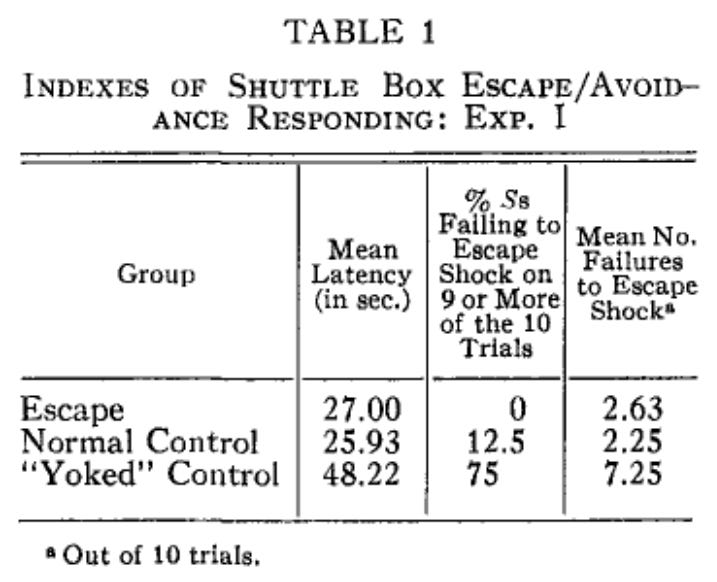
A decade later, Martin Seligman at the University of Pennsylvania formalized the concept through a series of controlled experiments with dogs. [2] In the most well-known of these, dogs were divided into three groups. One group received no shocks. A second group received shocks they could stop by pressing a lever. A third group received the same shocks as the second group but had no control over when they stopped. The shock ended only when their paired dog in the second group pressed its lever.
When all three groups were later placed in a shuttle box, a chamber where they could escape shocks by jumping a low barrier, the results were clear. Dogs in the first two groups quickly learned to escape. Most dogs in the third group simply lay down and accepted the shock, making no attempt to escape even though the barrier was easily cleared. They had learned, through prior experience, that their behavior had no effect on outcomes—and that learning transferred to an entirely new situation
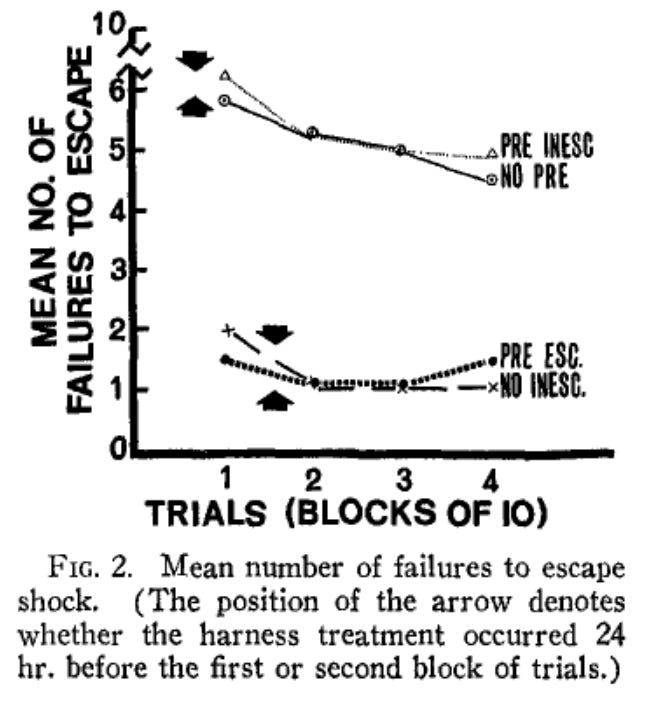
Seligman found one reliable cure. Experimenters physically moved the dogs through the motions of escape—picking them up and guiding their legs over the barrier. This had to be done at least twice before the dogs began jumping on their own. Threats, rewards, and demonstrations had no effect. The experience of successful escape had to be physically enacted to break the pattern.
Subsequent research confirmed that the same phenomenon occurs in humans. In one experiment, people performed cognitive tasks while exposed to distracting noise. Those who had access to a switch to turn off the noise performed significantly better than those who did not—even when the switch was never actually used. The mere presence of control was enough to change the outcome.
The Non-Fearful Rat
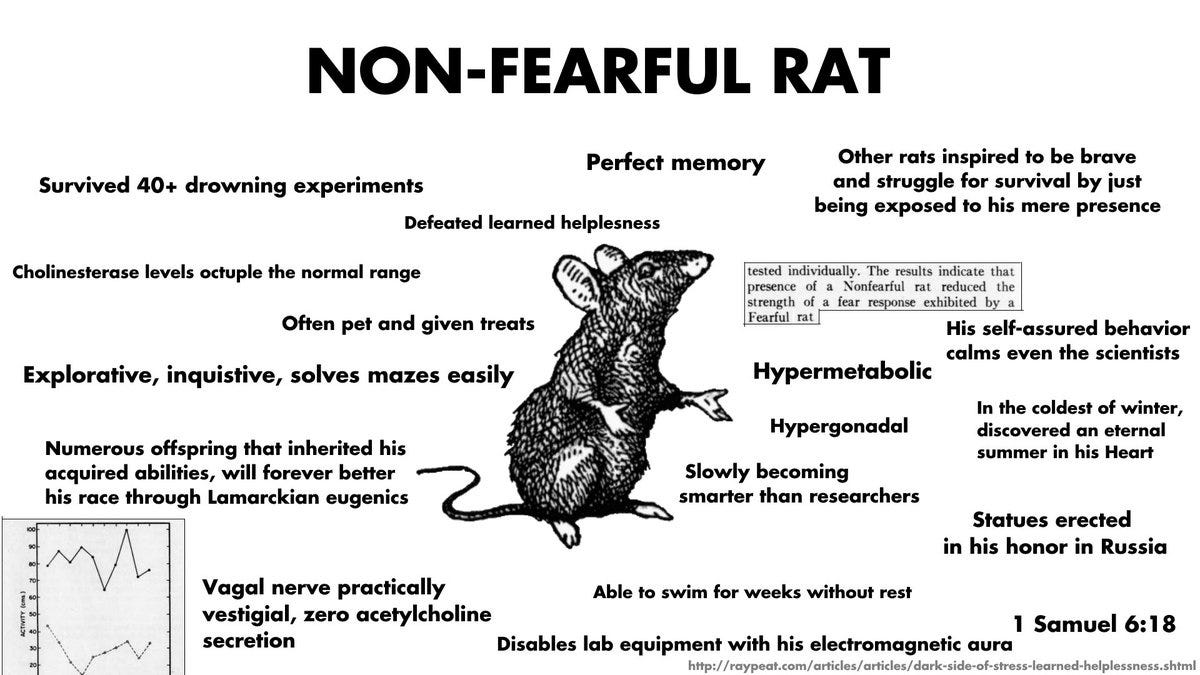
The image circulating in certain corners of the internet is a satirical but scientifically grounded portrait of the opposite of the helpless rat. It draws directly from the research tradition described above, particularly the enrichment experiments conducted at the University of California starting in 1960, and from Richter’s hopelessness work. [3]
The image attributes to this rat a set of characteristics that, taken together, describe the biological and behavioral profile of an animal that has been raised in a stimulating environment, has had repeated experiences of successful escape, and has developed both the neurological and physiological capacity to resist stress. Among the traits listed: cholinesterase levels at eight times the normal range, hypermetabolic and hypergonadal physiology, perfect memory, explorative and inquisitive behavior, and the ability to inspire similar resilience in other rats simply by being present.
The cholinesterase detail is not arbitrary. The Berkeley enrichment experiments found that rats raised in larger, more complex environments showed increased cholinesterase activity in their brains—the enzyme responsible for breaking down acetylcholine. This was associated with better learning, larger brain mass, and thicker cortical tissue. The offspring of these rats inherited similar advantages. [3] The non-fearful rat, in this framing, is the living product of an enriched environment—the biological inverse of the helpless one.
Ray Peat’s View
Ray Peat, a physiologist and independent researcher who wrote extensively on stress biology until his death in 2022, approached learned helplessness from a direction most mainstream psychology has not explored: the cholinergic nervous system.
Peat’s central argument was that the biological substrate of learned helplessness is an overactivation of the parasympathetic, cholinergic nervous system—the branch of the autonomic nervous system that governs rest, digestion, and repair, and which operates in opposition to the sympathetic fight-or-flight response. Richter’s observation that the hearts of hopeless rats slowed before death—indicating vagal, cholinergic dominance—was central to Peat’s interpretation.
Under normal conditions, the enzyme cholinesterase breaks down acetylcholine, keeping cholinergic activity in check. The Berkeley enrichment experiments showed that a stimulating environment increases cholinesterase activity, which Peat read as evidence that enrichment protects against the accumulation of acetylcholine that characterizes helplessness and stress-induced degeneration. Deprivation, in his view, does the opposite—it reduces cholinesterase activity and allows acetylcholine to accumulate, producing the biological conditions for passivity, cognitive impairment, and ultimately cell death. [4]
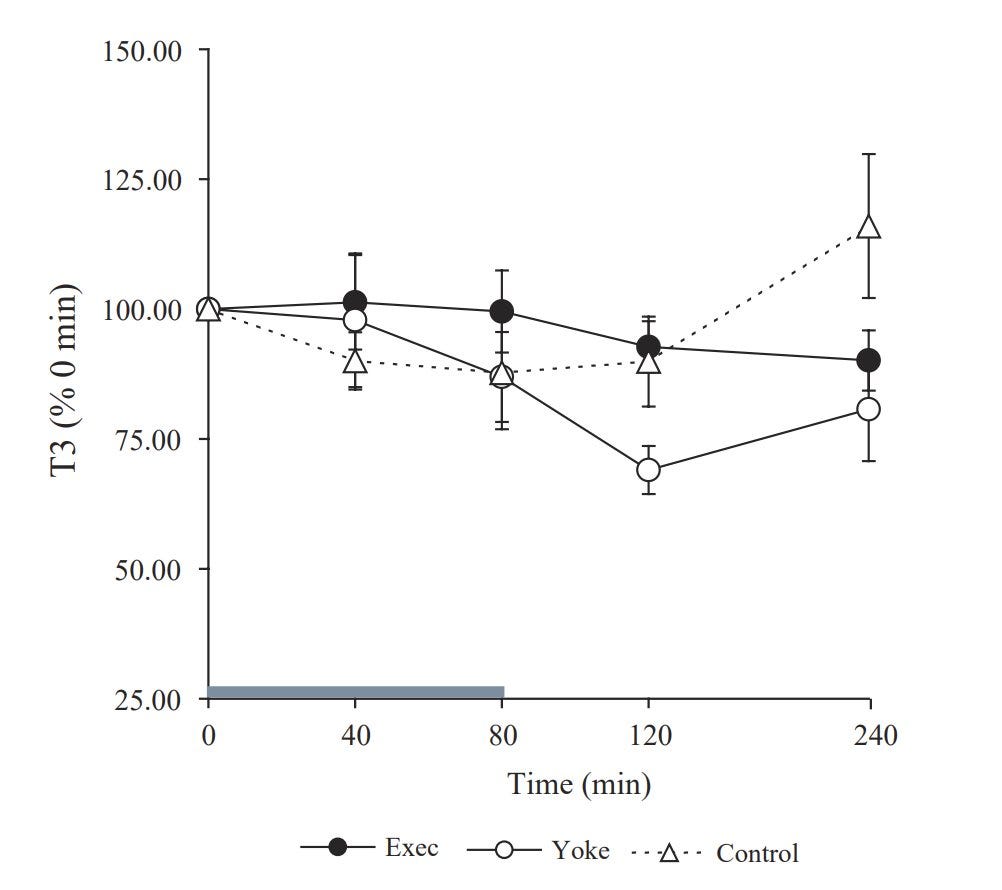
Peat drew a further line between the cholinergic system and thyroid function. During the development of learned helplessness, circulating T3 (the active form of thyroid hormone) decreases. [5] Removing the thyroid gland in animal models produces the escape deficit characteristic of learned helplessness. [6] Supplementing with T3 before exposing animals to inescapable shock prevents the development of helplessness, and after it has developed, T3 supplementation reverses it. [7, 8] Peat viewed this as evidence that thyroid function and cholinergic tone are deeply interrelated, and that conditions which suppress thyroid activity (e.g. chronic stress, nutrient deficiency, darkness) are also conditions that increase susceptibility to the helpless state.
“Environmental conditions that are favorable for respiratory energy production are protective against learned helplessness and neurodegeneration.”
— Ray Peat
Progesterone featured prominently in Peat’s framework as well. One of progesterone’s established functions is to increase cholinesterase activity, breaking down acetylcholine in the uterus to prevent premature contraction during pregnancy. Peat argued this function is general, not specific to reproductive tissue. Progesterone has been shown to protect against organophosphate poisoning, which works by inhibiting cholinesterase, and to improve recovery from traumatic brain injury.
Estrogen, by contrast, decreases cholinesterase activity, increasing cholinergic tone. Peat saw this as one of several reasons to view estrogen not as a uniformly beneficial hormone but as one that, in excess, tilts the biological environment toward stress, inflammation, and passivity. [9, 10]
The broader implication of Peat’s framework is that learned helplessness is not purely psychological. It is a physiological state with measurable biological correlates, and one that is influenced by the hormonal and metabolic environment of the organism. An enriched environment, adequate thyroid function, appropriate progesterone levels, and sufficient light exposure all work, in his account, against the conditions that produce helplessness. A depleted environment—one that restricts choice, limits stimulation, and produces chronic low-grade stress—does the opposite.
What This Means
The research on learned helplessness points to something that is both straightforward and underappreciated: the experience of control matters. Not just psychologically, but physiologically. The brain and body respond differently to conditions in which escape is possible than to conditions in which it is not, and repeated exposure to inescapable adverse conditions produces lasting changes in how an organism responds to adversity in general.
The cure, in both the animal models and the human literature, is consistent: a direct experience of successful escape or control. Not reassurance, not observation, but enacted experience. Richter’s rats needed to be rescued. Seligman’s dogs needed to be physically guided through the escape. The pattern breaks when the organism has an unambiguous experience of its own agency.

Peat’s contribution is to situate this in a broader biological context—one in which environment, hormones, metabolism, and the nervous system are all part of the same system, and in which the conditions that produce helplessness are the same conditions that impair thyroid function, suppress cholinesterase, and compromise cellular energy metabolism. On this view, the question of what produces a resilient organism is not separable from the question of what produces a healthy one.
[1] Richter (1957), On the Phenomenon of Sudden Death in Animals and Man
[2] Seligman & Maier (1967), Failure to Escape Traumatic Shock
[3] Krech et al. (1960), Effects of Environmental Complexity and Training on Brain Chemistry
[4] Anisman et al. (1981), Cholinergic Influences on Escape Deficits Produced by Uncontrollable Stress
[5] Helmreich et al. (2006), Peripheral Triiodothyronine Levels During Escapable and Inescapable Footshock
[6] Levine et al. (1990), Thyroparathyroidectomy Produces a Progressive Escape Deficit in Rats
[7] Brochet et al. (1987), Triiodothyronine Potentiation of Antidepressant-Induced Reversal of Learned Helplessness in Rats
[8] Massol et al. (1988), Triiodothyroacetic Acid Potentiation of Antidepressant-Induced Reversal of Learned Helplessness in Rats
[9] Jeyarasasingam et al. (2000), Tacrine, a Reversible Acetylcholinesterase Inhibitor, Induces Myopathy
[10] Franco et al. (2006), Hypothyroid Phenotype is Contributed by Mitochondrial Complex I Inactivation Due to Translocated Neuronal Nitric-Oxide Synthase
Great read! I have been very interested in this phenomenon for a long time and the applications it has when it comes to its martial application (and in practical contexts). Kick ass article.
A fantastic read.